
Hey There People Pleaser
I see you, you see me. We see each other lol

Happy Thursday o. Two KOnfessionals in a week? You’re welcome!

Before I get into this, I’ve realized The KOnfessional has morphed into a collection of “confessionals” I’m writing to free myself—and hopefully free someone else—from the various shackles we’ve put ourselves in over the decades we’ve been on earth.
And let me say this upfront: I check myself constantly to make sure NONE of what I’m saying here is self-derogatory. This is self-reflective—with a little shade here and there. LOL.
One of my favorite things to say is that I am a “recovering People Pleaser.” LOL. Seriously, I can’t count how many times I’ve used that line.
The Kunbi who grew up in a polygamous household, who always wanted to be seen amongst all the children at home, who wanted to be praised? She was always dancing for compliments and cracking the stupidest jokes just to be noticed. That girl—yeah. People Pleaser.
And funny thing is, the way I distance myself from her, like that Kunbi doesn’t exist anymore. When in reality, just like with the hoarding, it just shows up somewhere else.
Recovery requires constant awareness—a guard, if you will—to ensure you don’t slide back into old ways. We puff out our chest, pat ourselves on the back, and declare: I’m over that now. I’ve grown past it.
Meanwhile, the thing is just outside the window with a new disguise, waiting to slide back in.

This week, I got a harsh reminder. A client (who is also a friend) told me she was going with another attorney because it seemed like I didn’t have the capacity for her urgent matter. And she wasn’t wrong.
I felt gutted. Not because she was cruel about it—she was honest and kind. I felt gutted because she was right. Because my inability to simply say, “I don’t have capacity right now,” had backed me into a corner I couldn’t wiggle out of.
That’s what people-pleasing does in adulthood:
You take on things you shouldn’t.
You promise what you can’t deliver.
You stretch yourself so thin you’re transparent.
And then? You either do the work wrong or don’t do it at all. And everyone loses.
Say it with me: nobody wins when I People Please.
As if that reality check wasn’t enough, the very next day another friend—someone who had been trying to reach me for over a week—sent me a message: “Are you okay?”
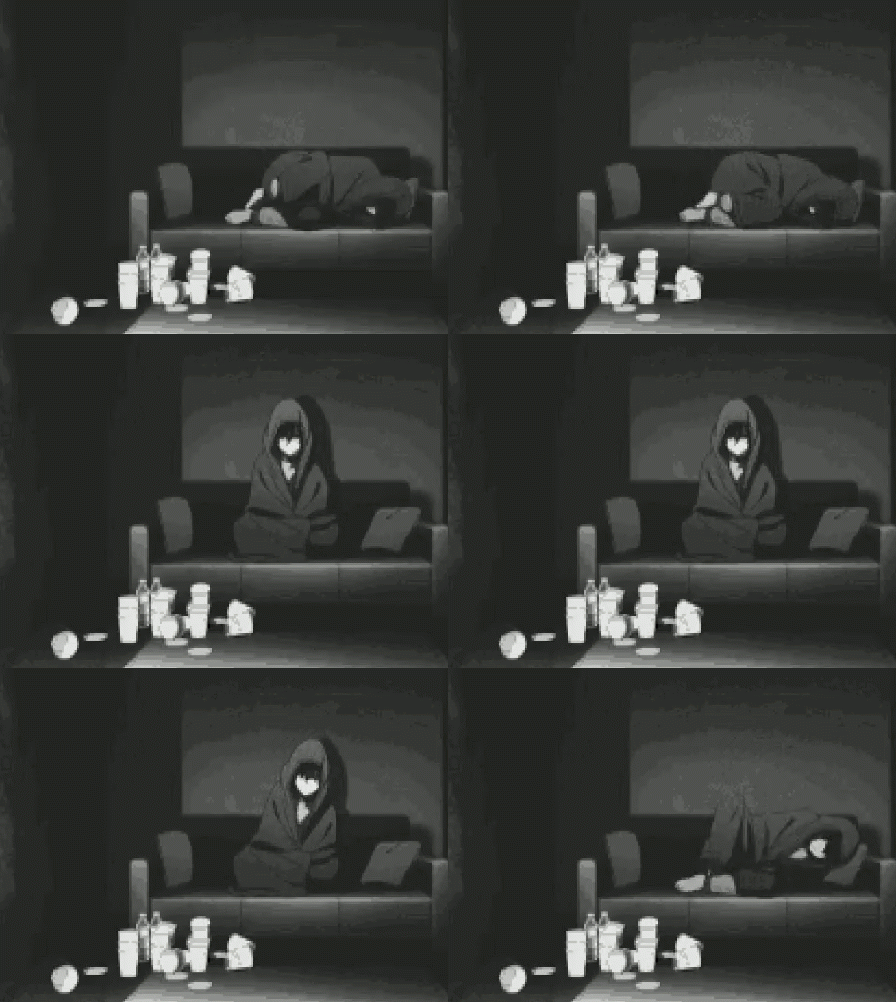
She could see through my silence. She knew I was dodging her, not because I didn’t care, but because I cared too much. I had spiraled into avoidance, shame, and guilt because I couldn’t do the thing she needed.
And that cut even deeper. Because that’s the hidden tax of people-pleasing—it isn’t just about work or deadlines. It bleeds into your relationships. It corrodes trust. It leaves you anxious and avoidant when all you had to do was say: I can’t right now.
It’s wild how people-pleasing wears the mask of generosity, but behind the mask it’s just anxiety in a party dress.

Speaking of Michael Scott lol, let’s talk about work for a second because “that one too dey”. People-pleasing doesn’t serve your clients either. Being a “yes man” isn’t necessarily what your client needs. Sometimes they need the hard truth. Sometimes they need you to be the “bad guy.” And for people pleasers? That’s the worst thing.
But the reality is: telling the truth, setting boundaries, saying “that won’t work” or “I can’t do that” is actually what makes you valuable. Being agreeable isn’t the same as being effective.
Then there’s the panic spiral—the freeze, the ghosting, the radio silence. You know the one. The sheer terror at the thought that someone is mad at you, or could become mad at you, or will be disappointed.
So instead of addressing it, you vanish. You freeze. You avoid. Which, of course, only makes the thing you were afraid of even worse.
Are you that person?
Well, welcome twin.

If this resonates with you, please know: I see you. I know how hard this is. You’re not weak. You’re not broken. You’re not lazy. You’re just human, carrying a reflex that used to protect you but now holds you hostage.
Awareness is the first step. Not perfection. Not bravado. Not “I’m cured!” Awareness. Because the truth is, you never fully recover from being a People Pleaser. You learn to watch it. To name it. To stop it before it takes over.
We have to stop treating recovery like it’s graduation. It’s not a diploma. It’s a daily practice. It’s maintenance. It’s choosing, over and over again, not to let that reflex run the show.
So maybe the work isn’t to become “not a People Pleaser.” Maybe the work is to become a truth teller. A boundary setter. A “this is what I actually can do right now” kind of person.
Because at the end of the day: nobody wins when you People Please. Not you, not them, not the friendship, not the work.
Here’s to us being free!

Xo
Kunbi